Thursday, September 23, 2021

adverb clause
ESL 265
complex
one independent clause + one dependent clause ( has one words attatched)
adverd clause
she is taking 18 units this quarter ,so she is very busy ( coordinating conjunction)
adverb clause
Mistake of puntuation (in paragraph)
time clause
tense you have to use
when /why/after/before
Time relation between two clause
Since shelter in place begab in march 2020 , i have been teaching online since online class started i have met many nice students. (simple past & present perfect )
Time line present perfect connect to the future abit
example ( since i have started teaching online i have met alot of nice student ( simple past)
Between ( preposition ) ( You can use the middle of something)
independent clause ( subject +. verb + complete idea )
(1)She is studying ESL at De Anza because she wanted to transfer to the San Jose State University
(2) Present perfect continious( example)
action began at the past and action continue until now
example sentences
(1) Since the shelter in place began in march 2020, I have been teaching online.
(2) I have owned my car since I started communiting over 17.
(3)Future tense ( will ) or ( going to )
Since i got my second vaccine , I have felt comfort to go out. ( simple past)
After I go my second covid vaccince , i felt so relieve . (stop in the past and continue in the present)
During ( both happening at the same time )
While the teacher was typing , one classmate joined zoom late
when I got home , my family was watching a moive
past continues show ( when I got home ,my family was watching a movie )
when I got home , we watched a movie ( they waited for me )
when , while, before ( time clauses)
Before
Before I start taking ESL 265 class , I have (taken 252 and 253class.
( correction Before I start taking ESL 265 class, I took 252 and 253 class )
Since I came to the US , my English has gotten better
Since I gave birth to my child, I have had so much meaning in my life.
SInce I got pregnant , my marriage life has become more meaningful.
I have liked to go to the beach since I moved to CA.
SInce covid 19 started my life have changed completely.
since ( from past to the present )
since ( mention as because )
adverb clause ( what is the two differences between )
because 0f ( we used with the phrase )
it is the way make you to make better at writing
same meaning but different form
Because of protest activity I can’t go back to my home country.
Because of too much stress , I can’t take a class
Because of the differet from the new management, I decided to quit my job
Because of a day full of meetings , I am exhausted today.
Because of my car battery light , i have to buy the new one
Because of the classes , i can’t have barbecue with my friend.
Because I came t the US , I learnd English
if you use Because of ( you can not have subject)
In Spite of the fact that ( because ) same meaning different phrase
In Spite of the fact that + subject + verb ( follow with the noun phrase )
writing you can use a lot of different technique ( same meaning different way of writing technique)
- Although
- Eventhough
Although I work very hard
Although I try my best of care , I can’t save him.
Adverb clause
pandemic and vaccine
In spite of vaccine
(1) 500 verb collocation
(2) words + preposition
Monday, January 18, 2021


Saturday, January 16, 2021
no good for drowning out the morons at he back of the bus
he press his phone into his ears .
Tomorrow he is going to bring his skinny puppy or the misfits . (misfits - something that doesnot fit or that fits badly)
or may be he would make a special bus tape with as a much screaming and wailing on its possible.
He could get back to New wave in November , after he got his driver license . His parents had already said park could have his mom's Impala and he have been saving up for a new tape deck. Once he stated driving to school , he could listen to whatever he wanted or nothing at all, and he could get to sleep in an extra twenty minutes.
(impala-nouns - a greaceful antelope often seen in large herds in open woodland in southern and East Africa .) origin late 19 cent from zulu i-mpala .(The term antelope is used to refer to many species of even-toed ruminant indigenous to various regions in Africa and Eurasia.)
"Thats doesn't exist " somebody shouted behind him.
"its so fucing does! " Steve shouted back . Drunken money style , man, it's a real fucking thing.
You can Kill somebody with it.
" You are full of shit "
" You are full of shit " Steve said . Park ! Hey park
Park Heard him , but did not answer sometimes , if you ignored Steve for a minute , he moved on to someone else . Knowing that was 80 percent of surviving with Steve as your neighbor. The other 20 percent was just keeping your head down.
Wednesday, January 13, 2021
Mystery box discussion maziah
1. What type of movies and TV shows does Abrams create?
He makes movies that contain some type of mystery that intrigues the audience and also one characteristic of his movies is that they have lots of visual effect that he creates by computer.
2. What childhood experience inspired Abrams' love of mystery?
First, his grandfather who was a technology expert and taught him how deferent devices(specially electronic ones like radio) work. Therefore, this has helped him to grow with lots of questions and answers. Second, the experience of magic store in New York city and he realized there that life is a mystery.
3. How does Abrams describe the type of magic that he lives to use in his work?
The type of magic that he use is using the magic box of computer by programing it to create stunning visual effect.
Mystery box discussion
1 According to editors of TED; Writer, director and producer J.J. Abrams makes smart, addictive dramas like TV's Lost, and films like Cloverfield and the new Star Trek.
Discuss mystery box
1. What types of movies and TV shows does Abrams create?

Sunday, January 10, 2021


Monday, December 7, 2020
within 10day time they have to leave the house because Margot was the call up from the Nazis camp
Anna thought she was going to another country but finally she knew that they are going to hide in the secret annes
the reality is they have to stay in the secret annex until the world war finish.
warehouse is underneath the secret annex
no looking out the window
no flashing the toilet
no walking around with shoe
she doesn't know how she is going to bear it
MIEP , Pim,
his father collected her favourite film star
its alright
they are very lucky
the first things we have to sew the curtain
so that no one can see it
we cannot call the doctor
12:30 they can start to move
Miep
Miep have a very brave husband
make jam
Mr vandan , mr vandan and son peter
frnk, mrs frank , anne , margot , mr dussal
we can use the bathroom to be finish by 8:30am
father was nice on her
they had to wear the yellow star
not allow to
her grandma die from cancer
That would be nice
received birthday gift a diary from Pim
she was so excited
at least we got each other
They have to keep quiet until 12:30 pm During the lunch hour they can relax and after 5:30 when they go home
Tuesday, December 1, 2020
the pixar story
the techinical transforming , collaboration and cooperation , invention and business
Pixar team begin at 1979,
needed special effect for star wars
phd computer science
to Lucasflim
ensemble ( graphic program , animation graphic equitment )
that included imaging computer , the pixar (could created high resolution image of anything from the building and car to tornadoes and aliens
In 1986, Lucas had to sell the group , the only taker was Steve Job.who had been just fired from apple. Job cashed in his apple stock and reportly paid 10 million to Lucas for the company renamed Pixar
Pixar began making animated filmed
Job poring 50million into film making with no profit
( Run by John Lasseter ) had to keep fighting to survive
1991 took even more drastic step
he would keep paying for Pixar only if the employees give all share to him , making him sole owner . JOb began looking around for a buyer.
Slavation seemed to come from Disney studios
en·sem·ble/änˈsämbəl/
Learn to pronounce
See definitions in:
all
music
physics
noun
noun: ensemble; plural noun: ensembles
1.
a group of musicians, actors, or dancers who perform together.
Friday, November 13, 2020
Thursday, November 12, 2020
British Schindler
Film about Nicholas Winton, rescuer of children from the Nazis, stars Anthony Hopkins
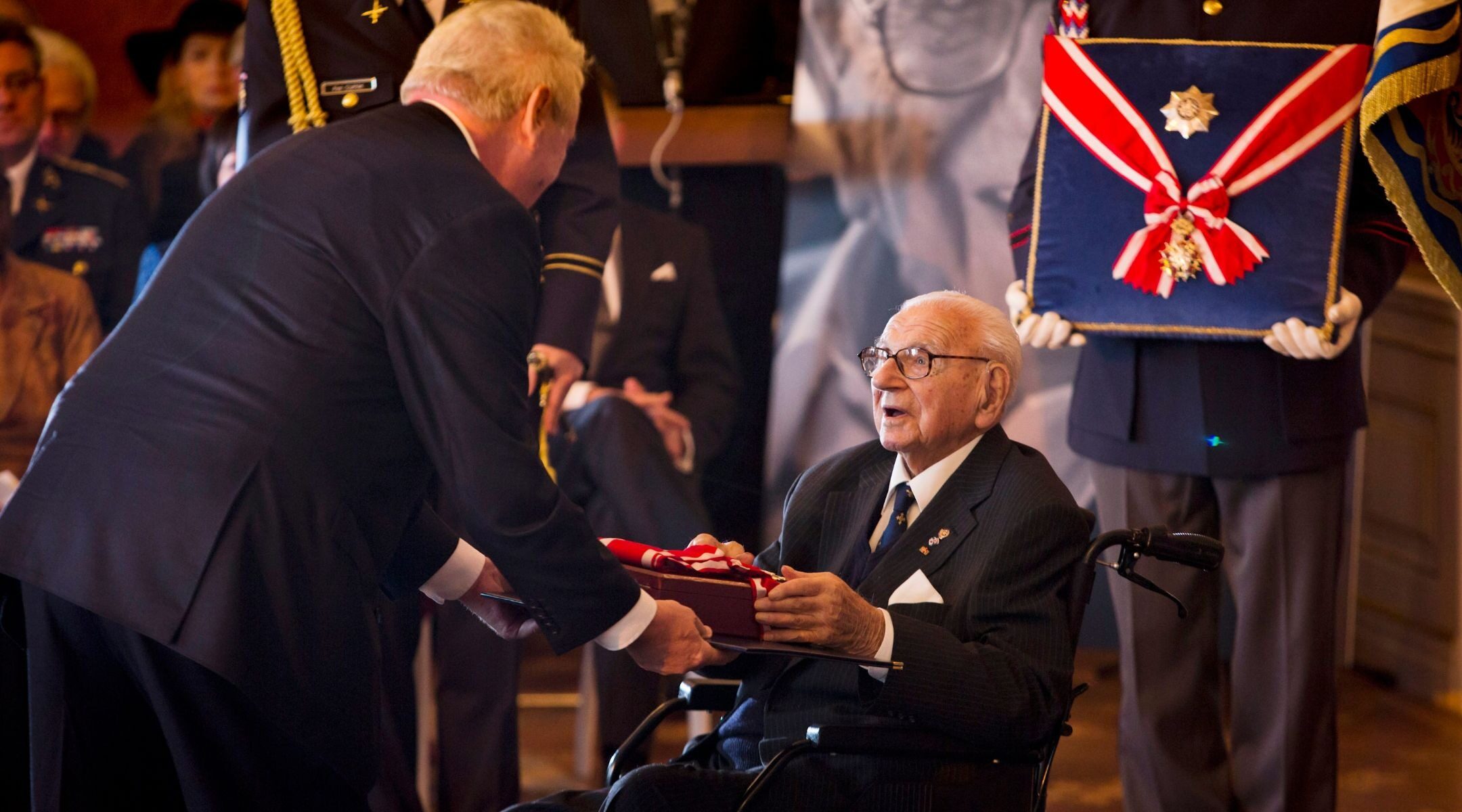
Sir Nicholas Winton, who saved 669 mostly Jewish children from the Nazis by organising their escape from occupied Czechoslovakia to Great Britain, receives the Order of White Lion, the highest order of the Czech Republic, from Czech President Milos Zeman during the Independence Day at Prague Castle on Oct. 28, 2014 in Prague, Czech Republic. (Matej Divizna/Getty Images)
(JTA) — A feature film about the life of Nicholas Winton, who saved 669 children from the Nazis, is in production with Oscar winner Anthony Hopkins in the lead role.
“One Life” has Hopkins playing an older Winton, Deadline Hollywood reported. British actor Johnny Flynn portrays the young Winton.
Winton, who is nicknamed “the British Schindler,” died in 2015 at the age of 106.
The baptized son of Jewish parents, Winton was a 29-year-old stockbroker when he arrived in Prague in December 1938. He was planning to go on a skiing holiday in Switzerland, but changed his plans when he heard about the refugee crisis in Czechoslovakia, which had just been occupied by the Nazis. In the following nine months, he organized eight trains that carried children, the vast majority of them Jewish, from Czechoslovakia to safety in Britain.
Winton’s heroism was unremarked until the 1980s, when his wife found evidence of the rescues. The discovery led to a surprise reunion with some of the children and a documentary. Winton received many honors in his later years, including a knighthood.
The “Schindler” reference is to the German industrialist Oskar Schindler, who is credited with saving some 1,200 Jews in the Holocaust. His story was made into the Academy Award-winning film “Schindler’s List” by Steven Spielberg.
Aisling Walsh is directing “One Life,” which was developed by BBC Films with See-Saw Films
Nicolas Winton
The 669 children of Sir Nicholas Winton

- Language Notes and Explanations
- infamous= wicked; abominable.
- dire straits = desperate situations, a metaphor from "difficult sea passages"
- to sense = to have a feeling that something is coming
- to bear witness = to testify, to provide evidence for something
- stockbroker = operatore di borsa
- to be displaced = to be forced to leave their home, because of war, persecution, or natural disaster.
- to set up shop = establish a business
- stationery = writing materials, as pens, pencils, paper, and envelopes. The etymology is from "articles sold by a stationer", that is a seller with a fixed location, often a bookshop licensed by universities.
- eventually = in the end (and not "eventualmente")
- ingenuity = inventiveness, creativity, imagination
- to wrestle = to fight
- to issue = to release a document
- blackmail = extortion (=ricattare). Etymology: The word is derived from the tribute paid by English and Scottish border dwellers to Border Raiders in return for immunity from raids; the tribute was paid in goods or labour, in Latin "reditus nigri", that is black + mail (tribute), being white mail a payment in silver.
- forgery = copy or imitation of a document, signature, banknote, work of art
- to cleanse = to get rid of something unpleasant
- to slaughter = the killing of cattle, sheep, etc., especially for food; referred to humans, the brutal or violent killing of a person (slaughterhouse= mattatoio)
- on behalf of = in the name of
- to be knighted = to receive a knighthood (or a damehood, its female equivalent), one of the highest honours an individual in the United Kingdom can achieve; the title of "Sir" or "Dame" will precede the name of the individual.
[0:19] His story begins at the end of 1938, with Europe on the brink of war. In Germany, violence against Jews was escalating, and the infamous Munich Agreement paved the way for Hitler's armies to march unopposed into Czechoslovakia.
[0:34] In London Nicholas Winton had been following events and knew that refugees fleeing the Nazis were in dire straits. He went to Czechoslovakia to see if there was anything he could do to help. What's strange is that for almost 50 years he hardly told anyone about what he had accomplished, and for 50 years the children knew nothing about who had saved them or how.
[1:10] We begin on October 1st, 1938. Nazi troops march into the Sudetenland, the German-speaking region of Czechoslovakia. Prague, the Czech capital, was flooded with desperate people trying to escape.
[1:24] A fortunate few were able to send their children abroad; these parents, mostly Czech Jews, sensed war was coming and wanted to get their children out. By chance, a cameraman filmed a man holding a boy, a 29-year-old Londoner, his name: Nicholas Winton.
"All I knew was that the people that I met couldn't get out and were looking for ways of at least getting their children out."
[1:56] Nicholas Winton is one of the few people who can bear witness to those days, because he is 104 years old. He told us he went to Prague to see if he might be able to save some people.
Bob Simon: "But what made you think you could do it?"
"Well... when I'm I work on the motto that if something is not impossible, there must be a way of doing it."
[2:20] Back in London, Winton was a successful stockbroker living the "good life", with a passion for sports. But he was deeply concerned about news reports in Czechoslovakia, of German persecution.
"I went out into the camps where the people who had been displaced were put, and it was winter, and it was cold..."
[2:40] Emigration wasn't an option, the world's doors were closed to the refugees, conditions in the camps were brutal for the 150,000 (hundred and fifty thousand) people trapped there, especially for the children. And no one focused on them, until Nicholas Winton. But what did he do? We went to Jerusalem to Yad Vashem, Israel's memorial to the victims of the Holocaust, and asked Dr David Silberklang, a senior historian there.
[3:10] "And Winton went, set up shop in a hotel in the centre of the old city in Prague and began looking into 'how can I organize getting some of the refugees, particularly the children out of here?'"
"What kind of experience did he have to qualify him for this immense bureaucratic task..."
"None."
[3:30] Winton set up a small organization with one aim: to get as many kids out, as fast as possible. People started coming to him in increasing numbers. He didn't have time in the day to meet them all. He worked till two in the morning, got up early in the morning to meet the next people, as more and more coming saying 'take my child out, take my child'!"
[3:49] By the time he returned to London he had a list of hundreds of children and set out to convince British authorities to take him seriously. He did it by taking stationery from an established refugee organization heading "Children's Section" and making himself "chairman".
[4:09] "So that eventually they had to adopt me."
"So, in fact you managed to do what you did through a little deception, a little smoke in mirrors..."
"Yes, to a certain extent yes"
"It required quite a bit of ingenuity..."
"No, it just required a printing press to get the notepaper printed."
[4:30] The Children's Section operated from a tiny office in central London. Winton's mother was in charge, the staff were all volunteers. During the day, Winton worked as a stockbroker; evenings, he wrestled with the British bureaucracy.
[4:51] "Did you approach any other countries to take some of the children? "
"Yea, Americans. But the Americans wouldn't take any, which was a pity, we could have got a lot more out."
[5:03] Winton had written president Roosevelt asking the US to take in more children. A minor official at the US Embassy in London wrote back: "the U.S. was unable to help". Britain agreed to accept the children, but only if Winton found families willing to take them in.
[5:21] So he circulated the children's pictures to advertise them, but even after a family chose a child, British authorities were slow issuing travel documents. So Winton started having them forged; he also spread some money around.
"Took a little bit of blackmail on my part.... "
[5:40] You were indulging in blackmail and forgery to get the children out." "I have never heard it put like that before..."
"But you seem to be enjoying it"
"It worked, that's the main thing."
[5:53] The first twenty children left Prague on March 14, 1939. The next day German troops occupied Prague and the rest of Czechoslovakia. Hitler rode through the streets triumphant. Hugo Meisl was 10 years old.
[6:09] "Do you remember the Germans coming into Czechoslovakia?"
"Not only do I remember, I personally saw Hitler standing up in the car and the children were expected to say 'heil Hitler' and so forth, I remember as if yesterday."
[6:27] It wasn't long before violence against Jews, property confiscation and forced labour that began in the Sudetenland spread throughout Czechoslovakia; but the Nazis allowed Winton's trains to leave in keeping with their policy to cleanse Europe of Jews.
[6:45] Hugo Meisl's parents decided it was time to put him and his brother on one of the trains.
"I remember that they told us that we were going to England, maybe two or three months, it would be a holiday for us, and that they would join us very shortly afterwards..."
"And you believed them?"
"Absolutely!"
[7:05] "Were your parents emotional when they said goodbye to you?
"No, I've asked myself that question many times, how my parents had the strength... I'm sorry! It never occurred to me that what they were saying to us was not true, in other words, that they realized that they would not be joining us within a short period of time."
[7:40] Over the spring and summer of 1939 seven trains carried over 600 children through the heart of Nazi Germany to Holland, where they took a ferry to the English coast. From there they caught a train to London; an 8th train, carrying 250 more, was scheduled to leave Prague on September 1st - but that's the day the war began.
[7:54] "They were all at the station..... even on the train, waiting to go and war was declared; so the train never left, never heard really what happened to all those children... "
"But there is reason to suspect that not many of them survived..."
"I think that's true. Yes"
[8:30] Two years after that last train the Nazis began implementing the "Final Solution", their plan to slaughter all the Jews of Europe. Czech Jews were rounded up and shipped to Theresienstadt, an old military garrison town about an hour north of Prague, their first stop on the road to annihilation. These tracks were the exit from Theresienstadt, the only exit. The tracks led East, the trains were called "Polish transports", destination: Auschwitz.
[9:05] Some 90,000 (ninety thousand) people took that one-way ride, among them almost all the children Sir Nicholas wasn't able to get out in time, their parents, and the parents of the children already in England.
"After the war you went back to Czechoslovakia. Was there one instant where you accepted the fact that your parents were dead?"
[9:20] "For three years we used to visit when trains came from Siberia especially when the Communists moved in, in 1948, a lot of people started coming back from Siberia, so I would go to the station, hoping. and when films were being shown of people walking in concentration camps, Auschwitz and so forth, there's so many shots being taken by the Germans and so forth... never stopped looking.
[10:20] The name of every Czech Jew murdered in the Holocaust is painted on the walls of Prague's Pinkas synagogue, over 77,300 names, including Arnoshtka and Pavel Meisl, Hugo's parents' names.
[10:42] And Nicholas Winton? During the war, he volunteered for an ambulance unit for the Red Cross, then trained pilots for the Royal Air Force. He got married, raised a family, earned a comfortable living. For fifty years he told hardly anyone what he had done.
[11:00] "A question which I know intrigues everyone who hears your story, is why did you keep it secret for so long?"
"I didn't really keep it secret, I just didn't talk about it..."
[11:16] "All this time you're in England, then you go back to Czechoslovakia, then you go to Israel, you still had no idea how your departure from Czechoslovakia had been organized?"
"Absolutely no idea"
"And you learn that by seeing it on television..."
"That's right!"
[11:35] In 1988 the BBC learned about Winton's story, and invited him to be part of a program. He had no idea that the people sitting around him were people he had saved.
"Can I ask... Is there anyone in our audience tonight who owes their life to Nicholas Winton? If so, could you stand up, please? Mr Winton, would you like to turn around? On behalf of all of them, thank you very much indeed!"
[12:22] "I suppose it was the most emotional moment in my life, suddenly being confronted with all these children, who weren't by any means children any more..."
"No they weren't, and for the first time they looked at you, and knew that you were the reason that they were alive"
"Yeah.... true..."
[12:45] "I wore this around my neck and this is the actual pass that we were given to come to England, and I'm another of the children that you saved..."
"Lady Milena Grenfell-Baines describes Winton as one of the most modest people she's ever met."
[13:04] "Why do you think he didn't say anything for fifty years?"
"I think it was in his nature, he really felt that he had done all he could and having got those children settled, he felt 'been there, done that, my job's done, I have other things to do'."
[13:20] Other things... For the last fifty years Winton has been helping mentally handicapped people and building homes for the elderly.
"We've just opened our second old people's home and it's full, and it's doing very well, and plenty of old people like me to go in..."
"But you're not there, you're at home..."
"Oh, I'd hate to go into one of my own homes... don't print that!"
[13:50] Sir Nicholas Winton!
In 2003 Winton was knighted and became Sir Nicholas Winton. In the Czech Republic he's become a national hero. He was celebrated in a documentary called "Nicky's family" but he isn't really comfortable with all the adulation.
"I'm not interested in the past. I think there is too much emphasis nowadays on the past, on what has happened, and nobody is concentrated on the present and the future".
[14:25] In 1939 Nicholas went and used a two-week vacation to go to Prague and ended up saving the lives of 669 children. In the decades since, of course, the children had children, who then had children and so on... and the numbers multiplied...
"If you want to summarize it in one sentence: 'guy takes a two week vacation'
"and ends up with 15,000 children... Yes, yes"
[14:55] A pretty good story...
"It's a great story"
"They've got children and grandchildren and great-grandchildren...
"and none of them would be here if it hadn't been for Sir Nick...
"That's right, yeah, terrible responsibility isn't it?"